Personalized cancer vaccines aim to direct the immune system to attack a tumor by targeting molecules it expresses. Designing one means answering two questions: which potential targets is the tumor expressing, and can those targets invoke an immune response?
Sid was diagnosed with osteosarcoma in November 2022, a rare cancer that begins in bone-forming cells. Using his openly shared molecular data, we explored both questions for his tumor with our AI model for neoantigen prioritization, informed by single-cell RNA data.
Predicting what the immune system could recognize
Cancer mutations can produce altered protein fragments called neoantigens. A personalized cancer vaccine aims to direct an immune response toward selected neoantigens. Deciding which ones to include is a central challenge: a tumor can contain many mutations, with different evidence supporting each potential target.
At Invoke Bio, our proprietary AI model, NEMo (Neoantigen Elimination Model), estimates probabilities of immunogenicity for CD8 and CD4 T-cell responses. These predictions capture two complementary routes to immune recognition, associated with MHC class I and class II presentation. They help us prioritize candidate neoantigens for inclusion in a personalized vaccine.
What distinguishes our approach is the biological signal the model learns from. As described in our NEMo research overview, we train on immunoediting: how mutations disappear or persist in tumors under immunotherapy. This brings evidence from tumor–immune interactions into prediction, beyond whether an altered protein fragment is expected to bind a presentation molecule.
For Sid's data, we paired the CD8 and CD4 predictions with a second layer of evidence from single-cell RNA data: is the mutated sequence transcribed in malignant cells, and is it detected across the tumor subclones we can assess? This way, our resulting tiers combine predicted immunogenicity with expression and clonality to guide target selection.
What single-cell RNA adds to the decision
Bulk RNA sequencing measures RNA pooled from a mixture of cells. Single-cell RNA sequencing (scRNA-seq) lets us examine that evidence within specific cell populations. For neoantigen prioritization, it helps distinguish expression across the sample from expression in cells classified as malignant.
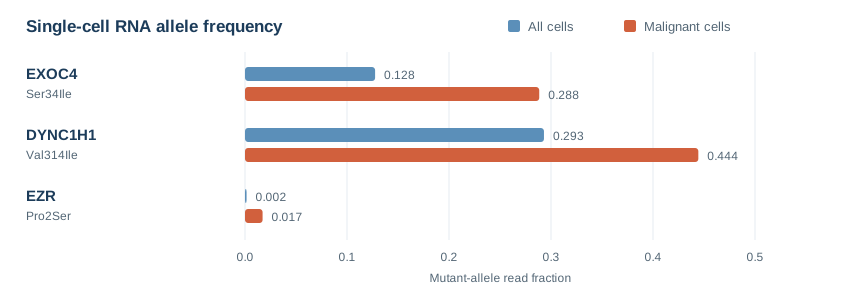
One example in the report is EXOC4 (Ser34Ile). Its mutant RNA read fraction is approximately 13% across all profiled cells and 29% within malignant cells. By letting us examine malignant cells separately, scRNA-seq reveals a stronger mutant RNA signal that is diluted when all cells are analyzed together.
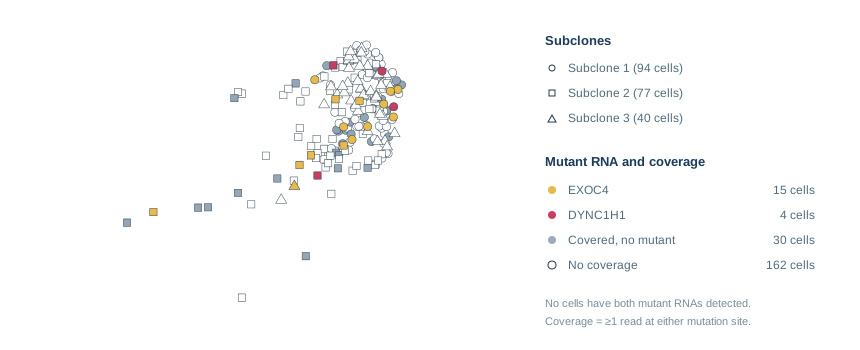
Single-cell data also let us examine variation within the tumor. Tumors can contain subclones: groups of cancer cells that share genetic changes. Sid's tumor has evolved through multiple recurrences and treatments, making it important to examine which potential targets are expressed in the sampled cells. Our scRNA-seq analysis inferred three subclones in Sid's tumor, represented by different shapes in the scatter plot below. Comparing mutant RNA across these groups lets us explore how broadly a potential target is expressed. For example, EXOC4 and DYNC1H1 show mutant RNA expression in the two subclones with enough coverage to assess them. Coverage was limited in the third subclone for these two genes: only one read at the EXOC4 mutation site and none at DYNC1H1. The figure distinguishes cells with detected mutant RNA, coverage without detected mutant reads, and no coverage.
Selecting targets for the cancer vaccine
For vaccine design, we combined our AI immunogenicity predictions with mutant RNA expression and coverage across tumor subclones to rank candidate targets. This brings together the likelihood of an immune response with evidence that the target is expressed in malignant cells and shared across the subclones we can assess. The two examples explored above, DYNC1H1 and EXOC4, appear in Tier 1 because they combine predicted immunogenicity, mutant RNA expression in malignant cells, and expression across all covered subclones. By comparison, the selected MAP2 candidate has a higher predicted probability of CD8 immunogenicity but lacks single-cell coverage in the displayed tumor fields and remains in Tier 3.
| Candidate | CD8 probability | CD4 probability | Tumor RNA mutant fraction | Subclones expressing / covered | Tier |
|---|---|---|---|---|---|
| DYNC1H1Val314Ile | 0.80 | 0.61 | 0.44 | 2 / 2 | 1 |
| EXOC4Ser34Ile | 0.47 | 0.59 | 0.29 | 2 / 2 | 1 |
| MAP2Gly868AlafsTer38 | 0.89 | 0.61 | n/a | n/a | 3 |
Want the full interactive analysis?
Explore the full reportMade possible by open data
Sid's decision to share his data made this work possible, allowing independent teams to bring complementary expertise to the same questions. We're grateful to Sid and the teams who generated and shared these resources, and we're honored to participate in his vaccine design process.
More data. More biology. More to come,
Invoke Bio Team